What I’ve Read in 2025
A year of books, a life built through them

“Until I feared I would lose it, I never loved to read. One does not love breathing.”
— Harper Lee
Some people collect stamps or wine; I collect lives. I find them bound in paper, waiting on shelves, stacked beside my bed, or sealed in the boxes of a library that, for now, mostly remains in Mexico. My condition has a name in Japanese — tsundoku, the art of acquiring books faster than you can read them. It may be a vice, but it is also a way of living: a form of curiosity made visible.
Books have shaped every chapter of my life. And for eight years now, I’ve ended December by looking back at what I’ve read — 2018 through 2024 — a private ritual that slowly became a public one. These lists are not about productivity or accomplishment. They are a map of my obsessions, my questions, and the worlds that accompanied me.
This year, 2025 was… full. Personally, professionally, emotionally. And the books reflect that.
Where It All Began
My earliest memories of reading involve Librería Parnaso in Coyoacán, Mexico City. My father and I would walk there to buy the newest Astérix; Astérix y la hoz de oro was the first one I remember carrying home, wrapped in thin paper, the excitement building before dinner. Soon came Tintín, Jules Verne, Emilio Salgari. Those books weren’t just stories — they were permission. Permission to imagine, to travel without leaving my room, to complete collections that felt like worlds.
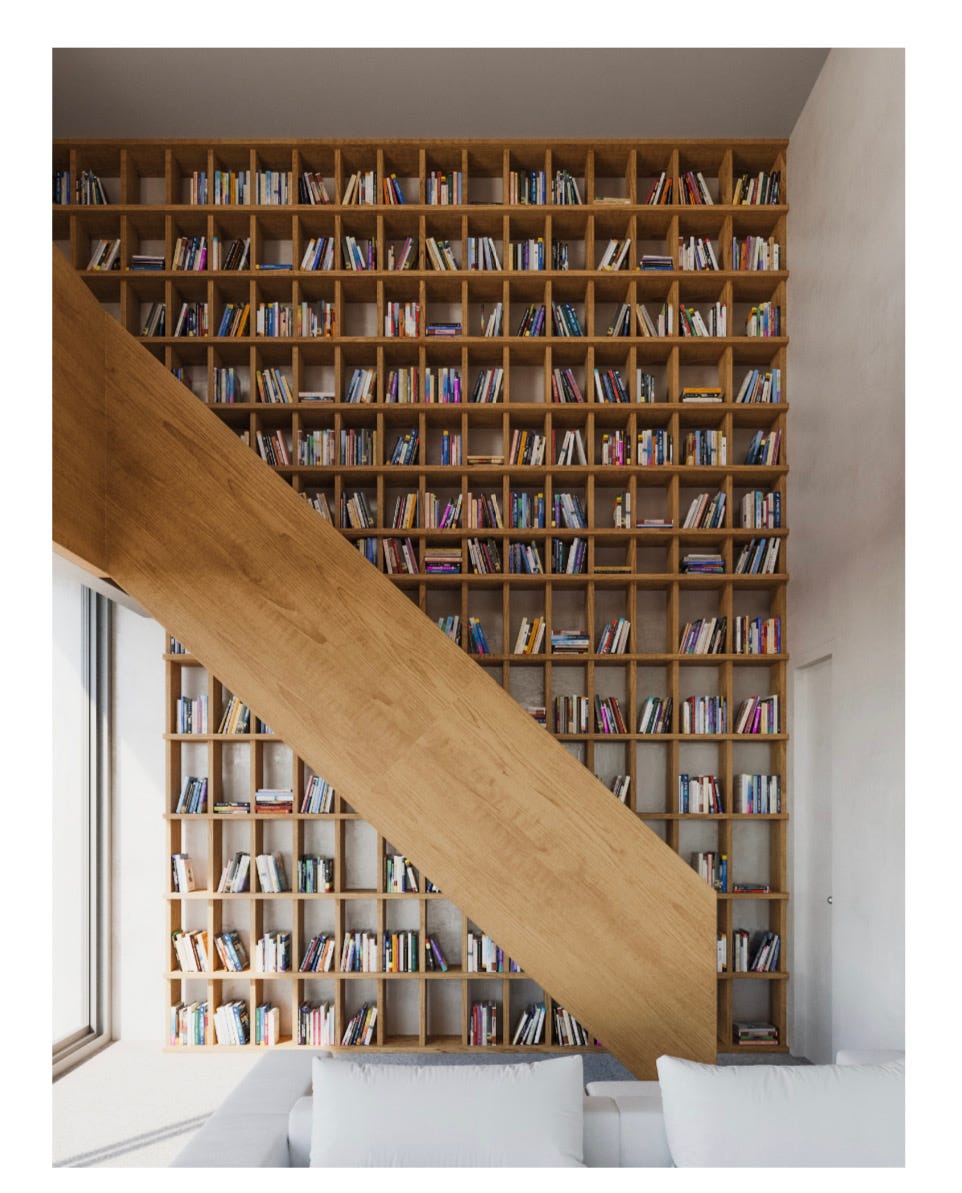
And then there was my uncle Luis’s Colección Austral — nearly 800 pastel-colored volumes lining the staircase wall of his house. Printed in the 1940s, organized by color: blue for novels, green for essays, orange for biographies, violet for poetry, grey for the classics, brown for science, and so on. Aristotle beside Montaigne, Dostoyevsky steps away from Melville, Lorca next to Neruda, Borges beside Unamuno. I remember running my hand along their spines, sensing that every color held a door into another universe. Years later, when I had the chance to buy the entire collection, I didn’t hesitate. It is still one of my most cherished possessions.
Those shelves — from Parnaso to Austral — built the reader I became.
How I Read a Year
I read between 60 and 70 books every year, and 2025 was no exception. I rarely read in a straight line. There is always an audiobook for runs, a novel on my nightstand, a non-fiction book for mornings, and another one tucked into my carry-on.
Some weeks I was deep in Hartmut Rosa, thinking about modernity and control; others I was wandering through rural Ireland with Niall Williams, or revisiting Dostoyevsky’s The Idiot. I explored political philosophy, climate science, psychology, AI ethics, and a couple of novels shorter than 150 pages — each one a distilled world.
This year I read authors from Spain, Mexico, Ireland, Iceland, the U.S., France, Italy, Morocco, Hungary, Serbia, Chile, Uruguay, and Japan — a reminder that literature is a global conversation, and that my reading life has become increasingly transnational.
The Standouts of 2025
Top 5 Fiction
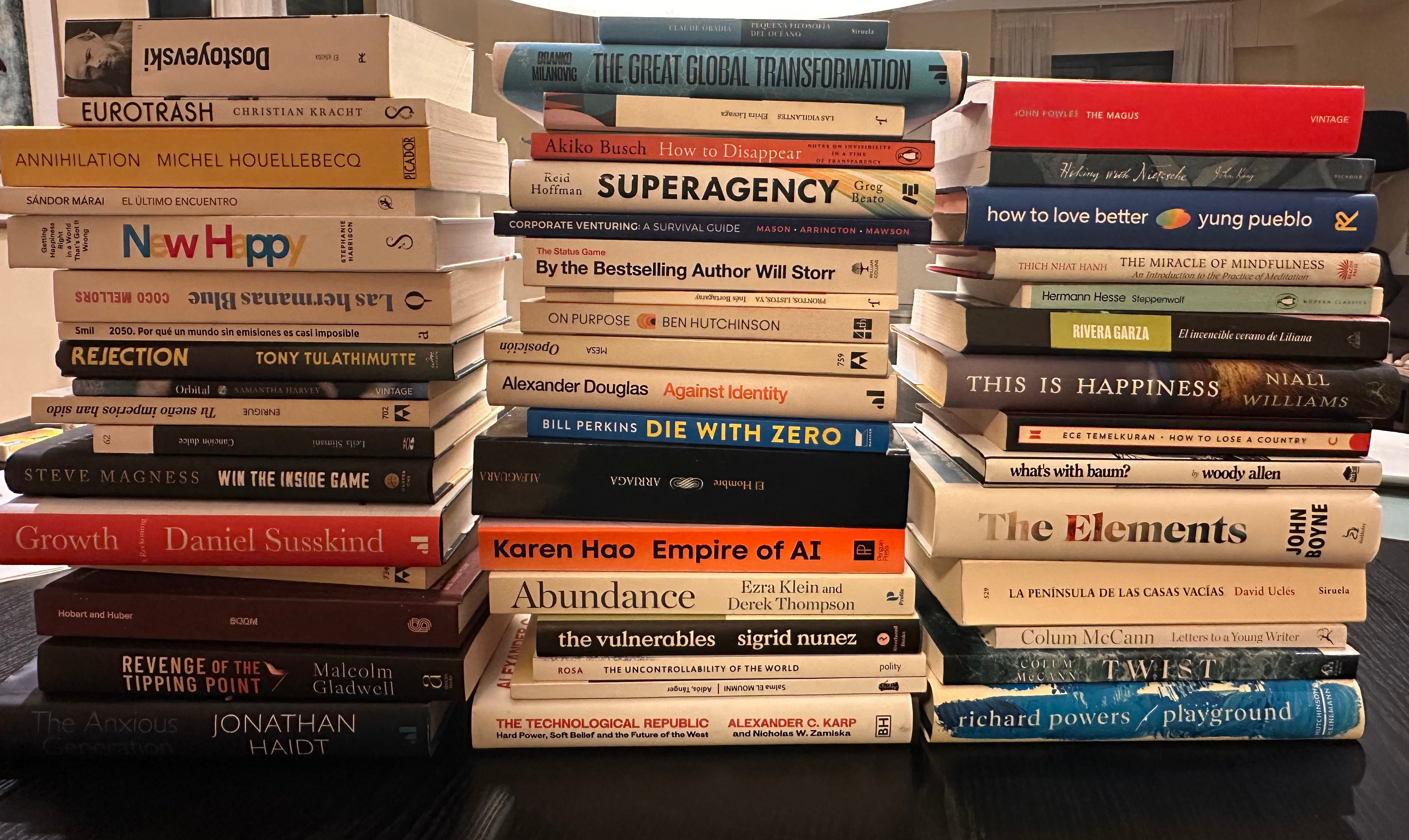
1. Orbit, by Samantha Harvey
A quiet astonishment of a novel. A mind turning inward, orbiting memory, time, and care. A book that rewards slowness.
2. This Is Happiness, by Niall Williams
The rare novel that slows your breathing. A tender, almost musical meditation on small Irish towns, love, rain, and the arrival of electricity.
3. The Magus, by John Fowles
A disorienting, seductive labyrinth, recommended by my friend Sergio. I read it half-frustrated and half-spellbound — exactly as Fowles intended.
4. The Idiot, by Fyodor Dostoyevsky
A long-delayed reading. Prince Myshkin’s innocence feels more contemporary than ever — a mirror held up to cynicism.
5. El invencible verano de Liliana, by Cristina Rivera Garza
A reconstruction of grief and sisterhood that blurs the line between literature and testimony.
Top 5 Non-Fiction
1. El loco de Dios en el fin del mundo, by Javier Cercas
Cercas approaches Pope Francis not as believer or critic but as a curious outsider — and in doing so, reveals the contradictions, humility, and complexity of leadership in our era.
2. The Uncontrollability of the World, by Hartmut Rosa
A framework for understanding the speed, anxiety, and loss of resonance in modern life. It influenced my thinking more than any other theoretical work this year.
3. Empire of AI, by Karen Hao
A journalist’s deep dive into OpenAI, ambition, broken promises, and the geopolitics of artificial intelligence.
4. Growth, by Daniel Susskind
An intelligent, rigorous reframing of economic expansion and what it means in a century defined by limits, climate, and inequality.
5. Clearing the Air, by Hannah Ritchie
Data made humane. A hopeful, science-grounded argument for a future that is still possible.
Books That Traveled With Me
(the ones that stayed longer than their pages)
Some books travel because they entertain; others because they demand something of you. These are the ones that stayed with me this year:
Against Identity, by Alexander Douglas — A compact dismantling of how we define ourselves.
La península de las casas vacías, by David Uclés — A powerful novel on the Spanish Civil War and the absences it left behind.
El hombre, by Guillermo Arriaga — Violence, morality, and masculinity written with precision.
Steppenwolf, by Hermann Hesse — A late reading for me; unexpectedly resonant.
Letters to a Young Writer, by Colum McCann — Craft and generosity woven into brief lessons.
The Status Game, by Will Storr — A useful lens for understanding power, ego, and ambition.
And many more that widened the year rather than simply passed through it.
I don’t track numbers to claim productivity; I track them because they reveal patterns about my mind.
In 2025 I’ve read 62 books, in English and Spanish, across more than 20 countries, (24% written by women), with a near-even split between fiction and non-fiction.
My reading took me to Ireland’s rural rainstorms, the corridors of the Vatican, OpenAI’s offices in San Francisco, the battlefields and ruins of the Spanish Civil War, the quiet interiors of Icelandic family life, New York apartments full of doubt, the philosophical forests of Nietzsche, and the psychological mazes of Fowles and Hesse.
It wasn’t a thematic year — it was an expansive one.
Why I Read
Reading is not escape for me — it is expansion. Books shape how I think, how I invest, how I parent, how I understand uncertainty. They help me rebuild after difficult seasons and find clarity when the world feels crowded.
It is also communal. I recommend constantly; friends write asking for “one book for this week,” and I love the challenge of pairing a person with a story. My daughter Ana reads as passionately as I do, and sharing books with her — trading underlines, arguing interpretations — is one of my life’s quiet joys.
And then there is the pleasure of discovery.
Walking into a London bookstore feels like entering a cathedral of possibility. I know how to search: scanning for new voices, trusting a bookseller’s handwritten note, letting instinct pull me toward something unexpected. That moment — the feeling that somewhere in here is a book that will rearrange me — never gets old.
Legacy in Paper
Most of my library still sits in boxes in Mexico, waiting for a house in Cantabria that does not yet exist. I miss the physicality of it: reaching mid-conversation for a book I know is on the third shelf; the patina of time on the corners; the sense of continuity that only books provide.
But I’ve come to understand that a library is not a monument — it is a diary. If you read my shelves in order, you’d trace my life: the ambition of my twenties, the curiosity of my thirties, the ruptures and rebuilding of my forties, and now, the depth-seeking calm of this new chapter.
When I finally open those boxes again, I’ll unpack them slowly, as one opens letters from an old friend. Not the house I built — but the one I’m still becoming.
And if I leave any legacy, may it be this:
not the books I have read, but the questions they have left alive.
Because a life, like a library, is never finished.
You can find more about me and my work at https://ferlelo.com
Hola Fer. Hace mucho tiempo leí una de tus publicaciones sobre los libros que leíste durante ese año. Me contagiaste tu curiosidad y ganas de aprender y fuiste un catalizador para cultivar el hábito de lectura en mi día a día. Muchas gracias por compartir!